
In my recent Medium post, I have backtested a simple forex strategy. I calculated the strength and weakness of the three main currencies (EUR, USD and GBP), and I was going long on the stronger, while going short on the weaker of the three.
To identify the stronger and weaker currencies, the strategy was simple. I calculated an index for those three currencies, and the stronger one was the currency whose index price was higher than its 10-day moving average (more than the rest). The weakest apparently was the opposite.
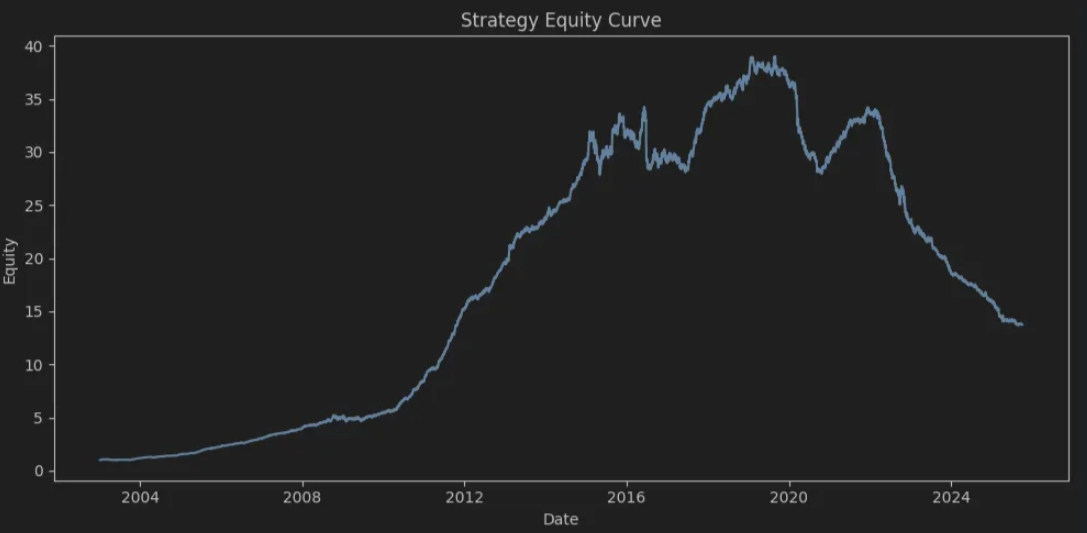
While it was a straightforward strategy, the results were exciting. Below is the equity curve of the strategy

The strategy has clearly experienced three distinct phases. Remarkably, from the start of our strategy in 2003 until 2016, it generated returns exceeding 3,500%. Following this period, the strategy entered a consolidation phase that lasted until 2022, when it began to decline sharply. But what caused this decline? Following some research (aka AI) I understood the following:
2003–2016: High Volatility and Macro Trends
During this period, the FX market was dominated by high volatility and macro trends. The Eurozone’s sovereign crises, together with frequent Central Bank interventions and Quantitative easing, favoured momentum and trend following strategies like the one we are investigating.
2016–2022: Consolidation and Range-bound Markets
After the high volatility period we just described, the markets entered a phase of low volatility with interest rates close to zero, which made the strategy practically useless since the trend of any currency could not provide any indication of whether a currency was trending or not. We could say that this period favoured more mean-reversion strategies rather than trend-following, like ours.
2022–Present: Structural Shifts and Reduced Edge
Then we entered the post-COVID era and its aftermath! Unprecedented policy interventions by central banks, global inflation, and uncertainty caused the strategy to lose significant money. This was a period where range trading strategies made more sense, since when a currency weakened, an intervention from the respective central bank would strengthen it and vice versa.
If you want to check the python code I developed and more insights you can go to the full Medium article.
Note that in this article, I used the EODHD APIs. Join EODHD through my affiliate link for a 10% discount. Your signup also supports my work and helps fund the creation of new content.🙏🏻